
The story behind Kirie
The inspiration for Kirie comes from Chinese 窗花 (chuānghuā): paper-cut decorations placed on windows.
A gift on the window
While thinking about a name for this project, I noticed the chuānghuā on my window. A friend gave it to me for Chinese New Year.
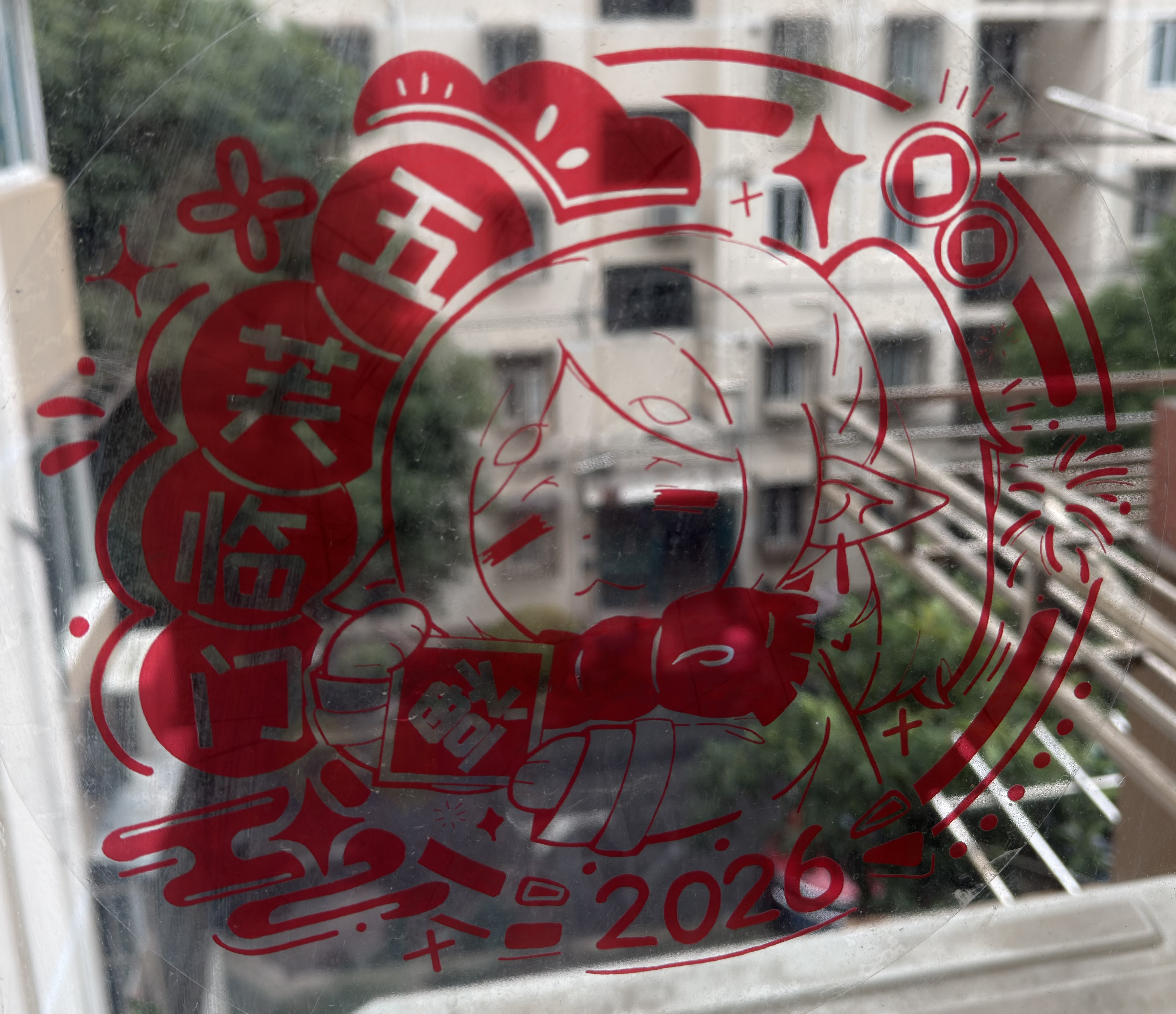
The chuānghuā on my window, given to me by a friend for Chinese New Year.
Looking at that decoration, I thought about the relationship between a Godot scene and the web interface over it. The paper decoration was attached to the window. What if I could put Web UI over a Godot scene in the same way?
The words on the decoration
The decoration reads 五芙临门, a pun on 五福临门: “May the five blessings come to your door.”
The character 福 means “blessing.” Here, it becomes 芙, taken from 芙莉莲 (Frieren). Both 福 and 芙 are pronounced fú, so the phrase keeps its sound while referring to Frieren.
The character on the decoration is Frieren from the anime 葬送的芙莉莲 (Frieren: Beyond Journey’s End). I find it a very comforting anime.
Web UI like chuānghuā
That became the image behind Kirie: put Web UI onto a Godot scene like chuānghuā on a window.
Godot runs the game and shows the scene. The web interface sits over that scene, adding the interface that the player sees and uses. The window decoration gave me a way to picture those two parts together.
The introduction explains how this idea works in a game.
Choosing a name people can say
The idea came from chuānghuā, but that word can be difficult to pronounce for people unfamiliar with Chinese. I wanted an easier name for people to use when talking about the project.
I also considered the Japanese name senshi. I decided against it because it could be confused with 戦士.
I chose Kirie, pronounced ki-ri-e, as the project name. The choice of name followed the pronunciation concern; the inspiration came from the Chinese window decoration my friend gave me.